
 Business License
Pipe Extrusion Process: A Step-by-Step Technical Guide
Pipe extrusion is the process of melting polymer resin and forcing it through a shaped die to form a continuous pipe, then calibrating, cooling, hauling, and cutting it to length. This method produces solid-wall, corrugated, and profile pipes from materials such as HDPE and PP for water supply, drainage, gas distribution, and industrial applications.
Why do two extrusion lines running the same material and die sometimes produce pipes with completely different quality? The difference usually comes down to process control. Temperature profiles, melt pressure, haul-off synchronization, and cooling rates must work together precisely. A small mismatch creates ripple, ovality, or weak weld lines that reject an entire production run.
At Qingdao Yongke Machinery, we have designed and commissioned extrusion lines for pipe manufacturers since 2010. Our equipment produces pipes from DN300mm to DN5000mm using both direct extrusion and spiral winding technologies. This guide walks through the complete pipe extrusion process so you can optimize your line, troubleshoot common problems, and choose equipment that matches your production goals.
Key Takeaways
Pipe extrusion converts polymer pellets into continuous pipe through melting, shaping, calibration, cooling, pulling, and cutting.
A complete extrusion line includes material handling, extruder, die head, calibration, cooling, haul-off, cutter, and stacking systems.
Critical process parameters are barrel temperature, melt pressure, die gap, line speed, and cooling rate.
Common defects such as ripple, ovality, and weld lines trace back to temperature, pressure, or synchronization issues.
The right extrusion equipment depends on material, diameter range, output target, and required automation level.
Want to see these extrusion principles applied to production equipment? Schedule a video factory tour with our sales engineer.
What Is the Pipe Extrusion Process?
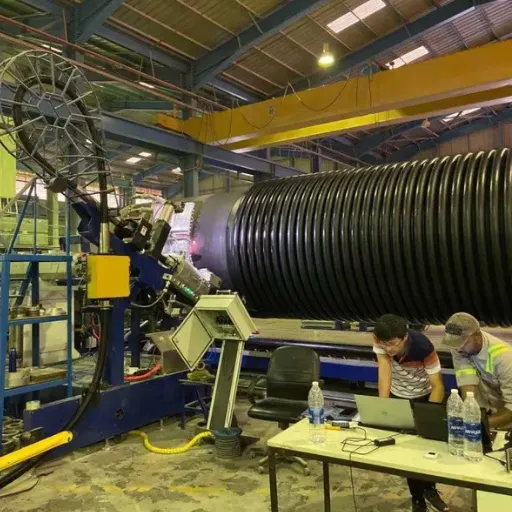
Pipe extrusion is a continuous manufacturing process. Polymer resin enters an extruder, melts and homogenizes, flows through a circular die, takes the shape of a pipe, and solidifies in a cooling line. The result is a continuous pipe that a cutter severs to standard or custom lengths.
This process differs from injection molding or blow molding because it produces long, uniform sections without seams or joints. It is the dominant method for manufacturing thermoplastic pipes because it offers:
High output rates for long production runs
Consistent wall thickness and diameter control
Material flexibility across HDPE, PP, PVC, and blends
Low labor cost per meter once the line is running
Easy integration of recycled material through co-extrusion
When Ahmed upgraded his pipe plant in Cairo in 2023, he moved from batch extrusion to a continuous single-screw line. His output per shift doubled, but he soon noticed periodic wall thickness variation. The root cause was haul-off speed fluctuation caused by worn caterpillar belts. Replacing the haul-off unit stabilized the line and reduced his scrap rate from 8% to under 2%. The lesson was clear: extrusion rewards attention to every subsystem, not just the extruder.
Types of Pipes Produced by Extrusion
Different die and calibration configurations produce different pipe types:
Solid-wall pipes: Uniform wall thickness for water, gas, and industrial pressure applications
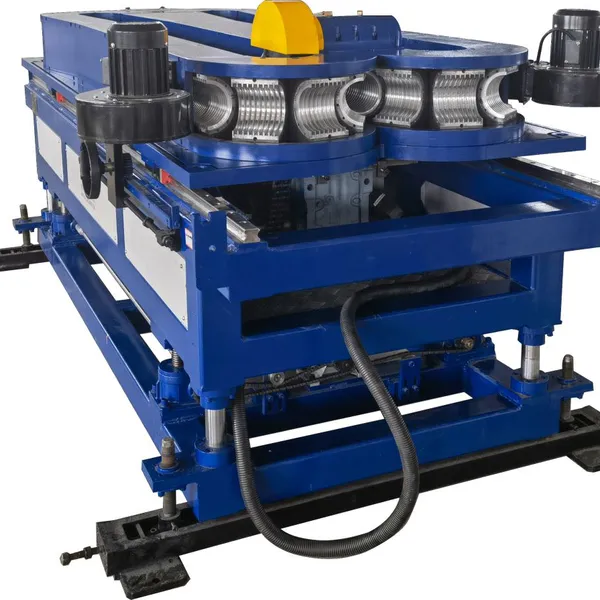
Single-wall corrugated pipes: Lightweight flexible pipes for drainage and cable protection
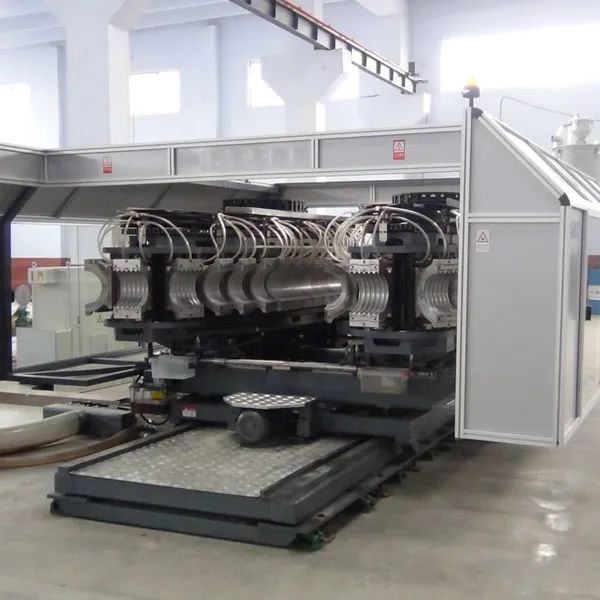
Double-wall corrugated pipes: Smooth inner bore with structured outer wall for sewer and drainage
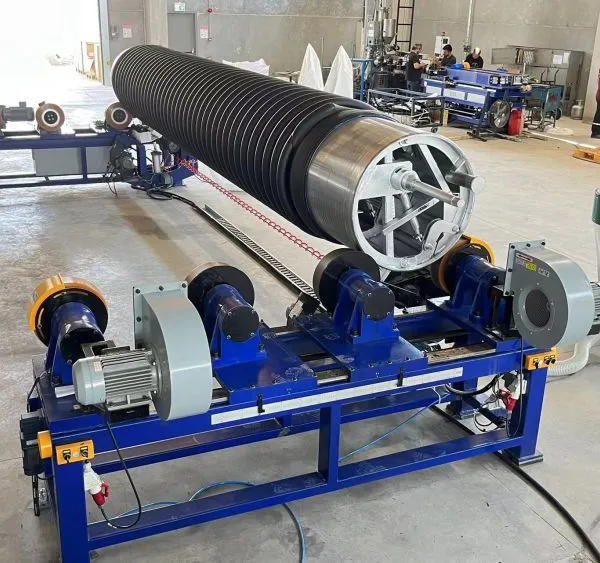
Spiral profile pipes: Structural wall pipes made by winding an extruded profile strip for large diameters
Each type uses variations of the same core extrusion process. For drainage and cable protection applications, high-speed PP corrugated pipe extrusion lines produce corrugated pipes efficiently. The equipment scales from small laboratory lines to industrial systems producing pipes several meters in diameter.
Finished pipes for municipal and industrial projects must comply with international standards such as EN 13476, ASTM F894, and ISO 21138.
Pipe Extrusion Line Components
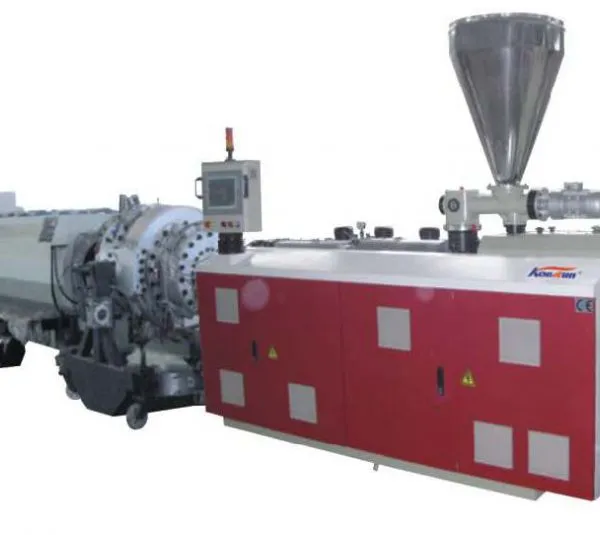
A complete pipe extrusion line is an integrated system. Each component affects the others, so buyers should evaluate the whole line rather than focusing only on the extruder.
Material Handling System
The material handling system feeds resin to the extruder consistently. Key elements include:
Silo or bulk storage for virgin resin
Drying hopper to remove moisture before extrusion
Blender for mixing virgin material with masterbatch, UV stabilizers, or recycled content
Vacuum loader that transfers material to the extruder hopper
Metal detector or separator to protect the screw and barrel
Moisture control is critical. Even small amounts of water in HDPE or PP can cause bubbles, surface roughness, and reduced mechanical strength.
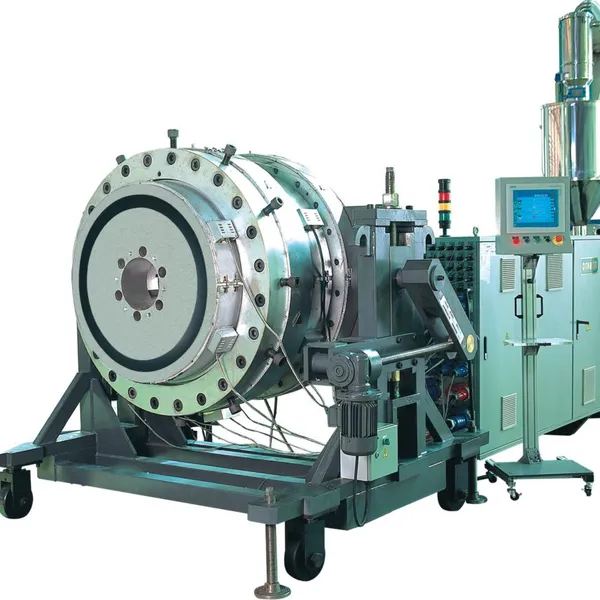
Single-Screw Extruder
The extruder melts and pressurizes the polymer. Important specifications include:
Screw diameter: Common sizes range from 45mm for small pipes to 150mm or larger for big-diameter lines
L/D ratio: Typically 25:1 to 33:1 for polyolefin pipe extrusion
Barrel zones: Multiple heating and cooling zones along the barrel control melting progression
Drive system: AC motor with gearbox provides torque and speed control
Screen changer: Filters contaminants and allows screen replacement without stopping production
The screw design must match the material. HDPE uses a different screw geometry than PP because the materials have different melt viscosity and thermal behavior. Furthermore, abrasive fillers or high recycled content may require specialized screw coatings or materials.
Die Head
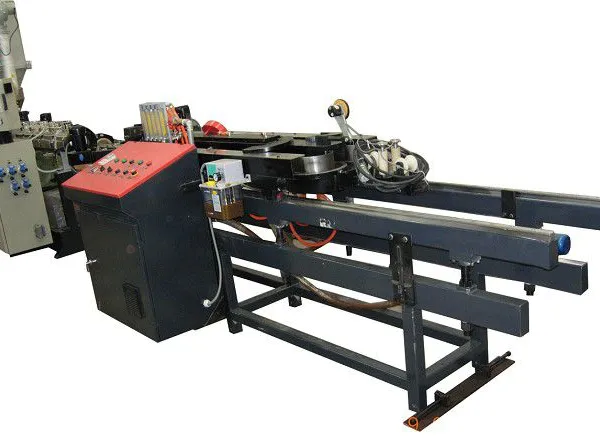
The die head forms the molten polymer into a pipe. For pipe extrusion, the most common design is the spiral mandrel die. It distributes melt evenly around the circumference to eliminate weld lines that weaken the pipe.
Key die parameters:
Die gap: Sets the wall thickness
Mandrel design: Determines internal diameter and melt distribution
Heating zones: Keep the melt at the correct temperature through the die
Adjustable lips: Allow fine-tuning of wall thickness during production
Modern dies include quick-change features that reduce changeover time between pipe sizes.
Calibration and Cooling System
After exiting the die, the hot pipe must be held to exact dimensions while it cools. Common systems include:
Vacuum calibration tank: Uses external vacuum to pull the pipe against a sizing sleeve while cooling water circulates
Pressure calibration: Uses internal air pressure to hold the pipe against an external calibrator
Spray cooling tanks: Additional cooling sections that bring the pipe to handling temperature
Cooling must be controlled. Too fast creates internal stress and warping. Conversely, too slow limits output and increases costs. Multi-section cooling tanks with independent temperature control offer the best balance.
Haul-Off Unit
The haul-off pulls the pipe at a constant speed synchronized with extruder output. Types include:
Caterpillar haul-off: Uses rubber or metal belts for most pipe sizes
Roller haul-off: For very large or smooth pipes
Belt haul-off: For small-diameter flexible pipes
Haul-off speed directly affects wall thickness. If the haul-off runs faster than extruder output, the wall thins. If it runs slower, the wall thickens and the pipe may buckle.
Cutter and Stacker
The cutter severs the pipe to length without stopping the line. Common cutters include:
Flying cut-off saw: Cuts while the pipe moves
Planetary cutter: For large-diameter pipes
Guillotine cutter: For smaller diameters
The stacker or coiler organizes finished pipes for inspection and shipment. Automated stackers reduce labor and prevent surface damage.
The video below shows how these components work together in a continuous pipe extrusion line. Replace YONGKE_VIDEO_ID with the actual video ID before publishing.
Want to configure an extrusion line for your pipe diameter and material? Explore our HDPE spiral profile pipe machine specifications.
Step-by-Step Pipe Extrusion Process
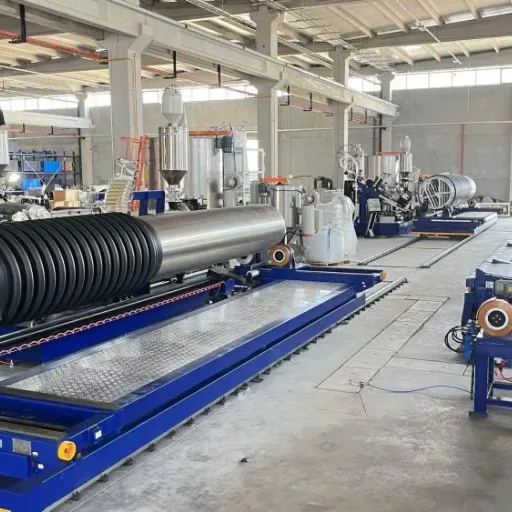
Understanding the sequence helps operators troubleshoot and optimize production.
Step 1: Material Preparation
Operators load resin into the drying and blending system. Virgin pellets may be mixed with recycled material, color masterbatch, or additives such as carbon black for UV resistance. The blend must be homogeneous to avoid color streaks or property variations.
Drying temperature and time depend on the material. HDPE is less hygroscopic than some polymers, but recycled blends and certain additives may require pre-drying.
Step 2: Melting and Homogenization
The extruder screw conveys the resin from the feed zone through compression and metering zones. Barrel heaters raise the temperature gradually. Shear from the screw also contributes heat. The goal is a uniform melt at the correct temperature and pressure.
Typical HDPE processing temperatures range from 180°C to 220°C depending on grade. PP runs at higher temperatures, typically 200°C to 240°C. Operators monitor melt temperature and pressure at the die entrance.
Step 3: Shaping Through the Die
The molten polymer enters the die head and flows around the mandrel. The spiral mandrel design forces melt outward through helical channels, creating uniform distribution. The die gap determines the initial wall thickness.
Die temperature must be stable. Cold spots cause early solidification and surface defects. Hot spots degrade the polymer and reduce mechanical properties.
Step 4: Calibration and Initial Cooling
The hot pipe enters the calibration sleeve immediately after the die. Vacuum pulls the outer surface against the sleeve while cooling water removes heat. This stage sets the outer diameter and roundness.
Calibration sleeve length and cooling water temperature depend on pipe size and material. Larger pipes need longer calibration and slower cooling to avoid internal stress.
Step 5: Secondary Cooling
After calibration, the pipe passes through additional cooling tanks. Spray cooling or immersion cooling brings the pipe to a temperature where it can be handled without deformation. Cooling length affects maximum line speed.
Step 6: Hauling and Cutting
The haul-off unit pulls the pipe at a controlled speed. The cutter activates at set lengths. Flying cut-off saws sever the pipe while it moves, so production continues without interruption.
Step 7: Inspection and Stacking
Operators inspect cut lengths for diameter, wall thickness, surface quality, and straightness. Accepted pipes move to the stacker or coiler. Rejected pieces are recycled or discarded according to quality procedures.
Key Process Parameters in Pipe Extrusion
Successful extrusion depends on controlling several interrelated parameters.
Temperature Profile
Barrel and die temperatures must be set for the specific material. The general pattern starts cooler in the feed zone and increases toward the die. Overheating causes degradation, discoloration, and reduced strength. Underheating produces unmelted particles and poor surface finish.
When Maria's team in São Paulo switched from PE80 to PE100 for a water supply contract, they kept the same temperature profile. The higher-viscosity PE100 did not melt completely, causing streaks and weak spots. Raising the metering and die zones by 10°C solved the problem and restored product quality.
Melt Pressure
Melt pressure at the die indicates how well the material is melting and flowing. Low pressure may mean insufficient feed or worn screw/barrel. High pressure can indicate a blocked screen pack, cold die, or incorrect die design.
Line Speed and Haul-Off Synchronization
Extruder output and haul-off speed must match. Synchronization errors cause wall thickness variation, pipe stretching, or buckling. Modern lines use closed-loop control to maintain the relationship automatically.
Cooling Rate
Cooling rate affects crystallinity, internal stress, and dimensional stability. Fast cooling increases productivity but can lock in stress that causes warping or reduced impact resistance. Slower cooling improves quality but limits output.
Die Gap and Centering
The die gap must be uniform around the circumference. Eccentric centering produces pipes with uneven wall thickness. Operators use feeler gauges and ultrasonic wall-thickness sensors to verify and adjust the gap.
Common Pipe Extrusion Challenges and Solutions
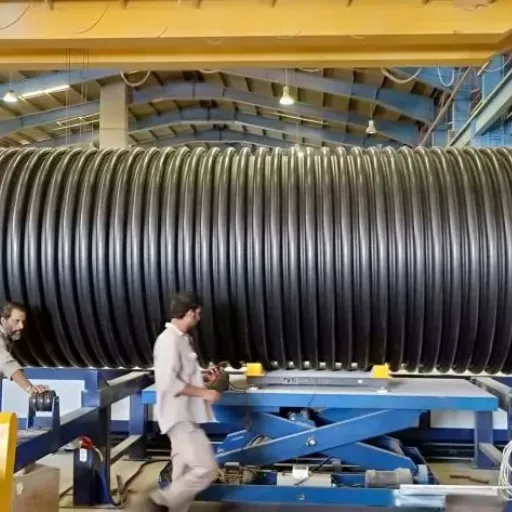
Even experienced operators encounter defects. Here are the most common issues and their typical causes.
| Defect | Likely Cause | Solution |
|---|---|---|
| Wall thickness variation | Uneven die gap or haul-off speed fluctuation | Center die, check haul-off belts and drive |
| Surface ripple or sharkskin | Melt fracture from excessive shear or low die temperature | Raise die temperature, reduce output, or modify die design |
| Ovality | Insufficient vacuum or uneven cooling | Increase vacuum, balance cooling water flow |
| Internal weld lines | Poor mandrel design or low melt temperature | Use spiral mandrel die, increase melt temperature |
| Bubbles or voids | Moisture or trapped air | Dry material, vent extruder, check feed throat design |
| Discoloration or degradation | Overheating or long residence time | Reduce barrel temperatures, increase screw speed, clean die |
When a producer in Vietnam started seeing surface ripple on DN110mm HDPE pipes, the first assumption was die wear. After checking temperatures, the actual cause was a die zone set 15°C too low. Raising the temperature eliminated the ripple without changing the die. This example shows why temperature should be checked before replacing hardware.
Materials Used in Pipe Extrusion
Material selection drives processing parameters and end-use performance.
High-Density Polyethylene (HDPE)
HDPE is the most common pipe extrusion material. Grades PE80 and PE100 dominate water and gas distribution. HDPE offers:
Excellent chemical resistance
Good toughness and flexibility
Strong fusion welding characteristics
Long service life in buried applications
HDPE extrudes at lower temperatures than PP and tolerates some processing variation.
Polypropylene (PP)
PP provides higher stiffness and temperature resistance than HDPE. It is common for drainage, industrial effluent, and hot-water applications. PP-HM grades enable thinner walls with equivalent stiffness.
PP requires tighter temperature control and is more sensitive to oxidation. Therefore, proper stabilization packages are essential for long-term performance.
Co-Extrusion and Recycled Material
Co-extrusion uses multiple extruders to create multi-layer pipes. A common design places virgin material in the inner structural layer and recycled material in outer layers. This reduces cost while maintaining performance for non-pressure applications.
At Qingdao Yongke Machinery, our co-extrusion systems can process up to 80% recycled HDPE or PP in outer layers. This supports both cost optimization and sustainability requirements for municipal projects.
Selecting Pipe Extrusion Equipment
Choosing the right extrusion line requires matching equipment capabilities to production requirements.
Define Your Product Range
Start with the pipe diameters, wall thicknesses, and materials you plan to produce. A line optimized for DN200mm water pipes will not efficiently produce DN1200mm drainage pipes. Consider both current needs and likely future expansion.
Evaluate Extruder Output
Extruder size determines maximum output. Larger screws produce more kilograms per hour but cost more and consume more energy. Match extruder capacity to your target output rather than oversizing.
Check Downstream Integration
The calibration tank, cooling length, haul-off, and cutter must handle your largest pipe diameter. Undersized downstream equipment becomes the production bottleneck even if the extruder has capacity.
Consider Automation Level
PLC-controlled lines with HMI interfaces offer:
Recipe storage for different products
Real-time monitoring of temperature and pressure
Automatic diameter and wall thickness control
Production logging and remote diagnostics
Higher automation reduces operator dependence and improves consistency.
After-Sales Support
A reliable supplier provides installation supervision, operator training, spare parts, and remote technical support. At Qingdao Yongke Machinery, we include technical documentation and video training with every line.
Pipe Extrusion Process FAQ
What is the pipe extrusion process?
Pipe extrusion is a continuous manufacturing process that melts polymer resin, shapes it through a circular die, calibrates and cools it, then hauls and cuts it to length. It produces solid-wall, corrugated, and profile pipes from materials such as HDPE and PP.
What are the main components of a pipe extrusion line?
The main components are the material handling system, single-screw extruder, die head, calibration tank, cooling tanks, haul-off unit, cutter, and stacker or coiler.
What temperature is used for HDPE pipe extrusion?
HDPE pipe extrusion typically uses barrel and die temperatures between 180°C and 220°C, depending on the resin grade and pipe size.
What causes wall thickness variation in extruded pipe?
Wall thickness variation usually comes from uneven die gap, worn haul-off belts, speed synchronization errors, or unstable melt pressure.
How does vacuum calibration work in pipe extrusion?
Vacuum calibration pulls the hot pipe against a cooled sizing sleeve using external vacuum. This holds the outer diameter and roundness while the pipe solidifies.
Can extrusion lines use recycled plastic?
Yes. Co-extrusion lines can use recycled HDPE or PP in outer layers while maintaining a virgin inner layer for structural integrity. Some systems process up to 80% recycled content.
Conclusion
The pipe extrusion process turns raw polymer into the pipes that carry water, gas, sewage, and industrial fluids worldwide. Success depends on understanding each step from material preparation through cutting, and on controlling the parameters that affect melt quality, dimensions, and mechanical properties.
Key takeaways from this guide:
A complete extrusion line integrates material handling, extruder, die, calibration, cooling, haul-off, and cutting systems.
Temperature, pressure, line speed, and cooling rate must be controlled together for consistent quality.
Common defects usually trace to specific process parameters rather than mysterious machine problems.
Material selection between HDPE and PP affects processing temperatures and end-use performance.
Equipment selection should match your diameter range, output target, material strategy, and automation needs.
At Qingdao Yongke Machinery, we engineer complete pipe extrusion and spiral profile pipe production lines for manufacturers around the world. Whether you need a line for small-diameter corrugated pipes or large-diameter structural wall pipes, our team works with you to configure the right solution.
Recently Posted
-
Qingdao Yongke Machinery: Full-Category Spiral Pipe Equipment from China's Qingdao
September 1, 2026Choosing a machinery supplier for large-diameter plastic pipe production is a long-term decision, because the line you install wil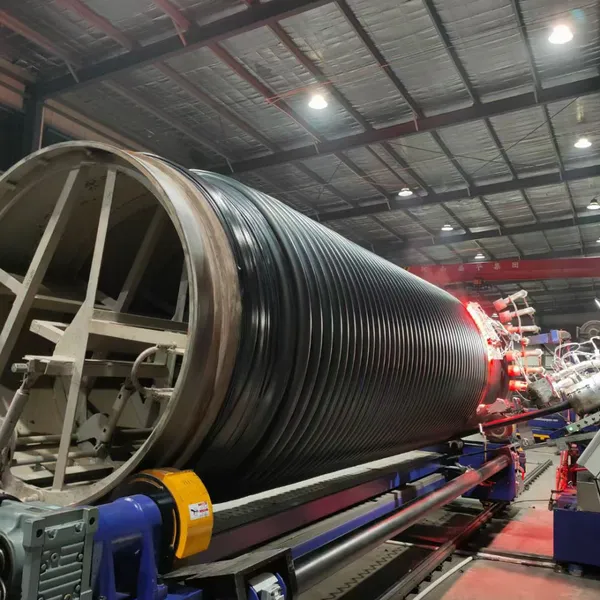 Read More
 -
Quality Control in Spiral Pipe Machine Manufacturing
August 31, 2026A buyer in South America some time ago received a winding line that looked complete on the surface but suffered repeated seam defe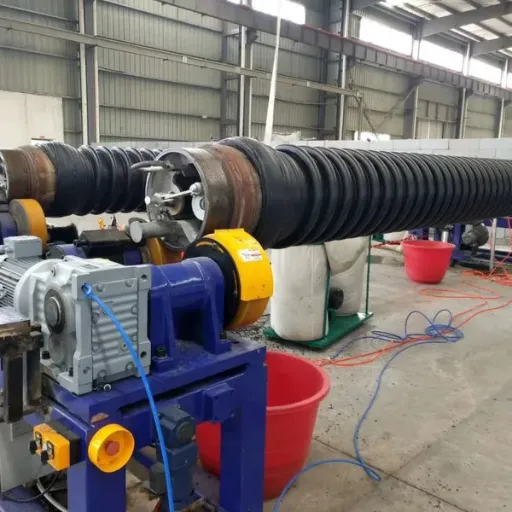 Read More
 -
Spiral Pipe for Sewage and Drainage Networks: Production Notes
August 28, 2026A municipal contractor in Eastern Europe some time ago took delivery of spiral-wound sewer pipe that looked flawless on the line.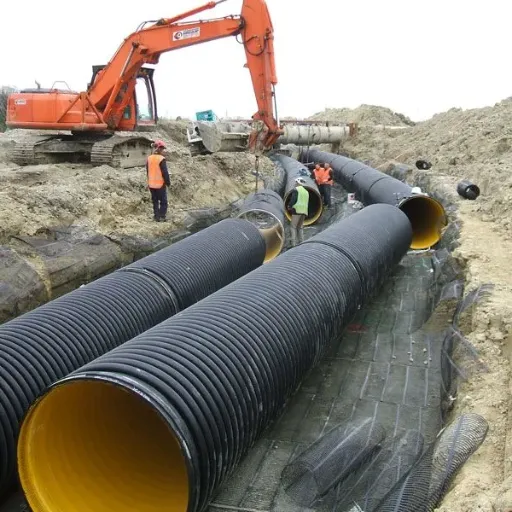 Read More
 -
DN300 to DN5000: Diameter Range and Machine Configuration
August 27, 2026A plant owner in Central Asia once asked for a line "up to DN5000" because a future tender mentioned large storage tanks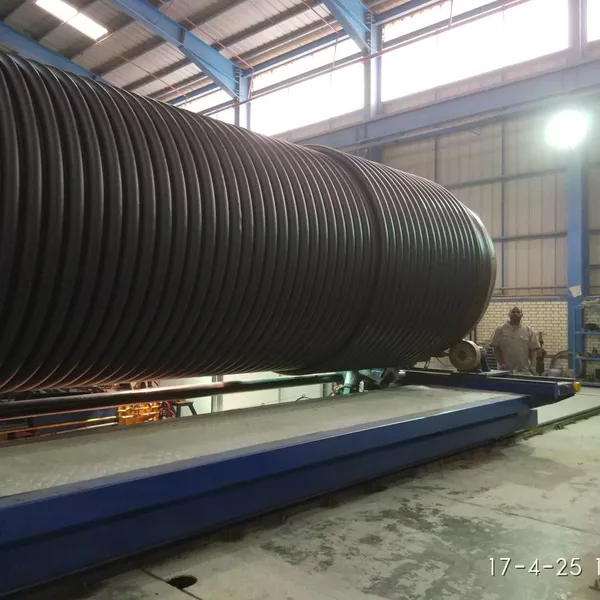 Read More

Contact Us
Recommended Products
-
 CIPP Glass Fibre Liner MachineNegotiableMOQ: 1 Set
 -
HDPE Helically Wound Tank MachineUS$ 10MOQ: 1 Set
-
CIPP Glass Liner MachineNegotiableMOQ: 1 Set
-
CIPP Felt Liner Manufacturing MachineNegotiableMOQ: 1 Set
-
Large Diameter HDPE Sea Intake Outfall Structured Wall Pipe Making MachineNegotiableMOQ: 1 Set
-
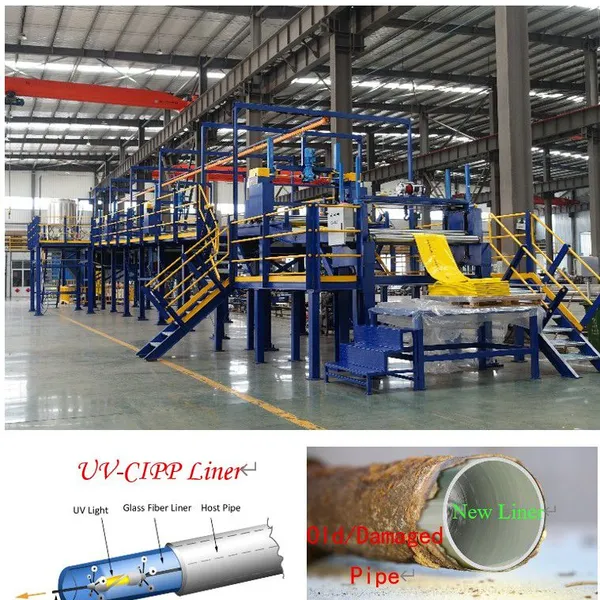
UV-CIPP Glass Fibre Liner Manufacturing MachineUS$ 1000 - 110000MOQ: 10 Meters
-
HDPE Pipe Extrusion Machine / PE Pipe Production Line With High OutputNegotiableMOQ: 1 Set
-
UV-CIPP Glass Fiber Liner Hose Production LineUS$ 1000 - 110000MOQ: 1 Set
-
HDPE Spiral Structure Wall Pipe MachineNegotiableMOQ: 1 Set
-
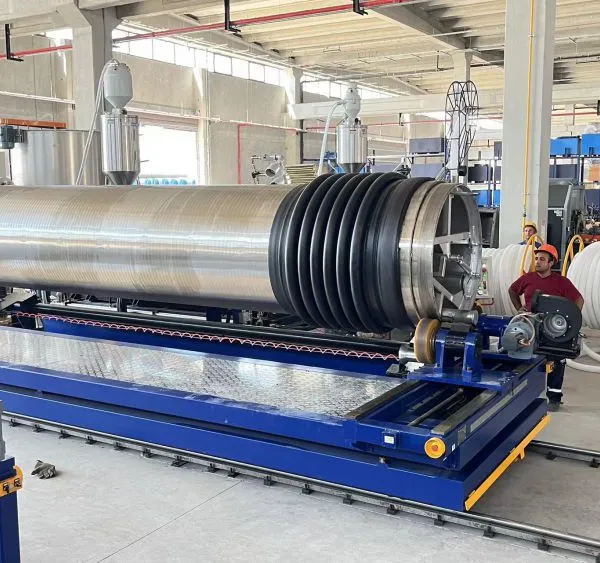
HDPE Spiral Pipe MachineNegotiableMOQ: 1 Set
-
HDPE Spiral Tank MachineNegotiableMOQ: 1 Set
-
Krah Pipe MachineNegotiableMOQ: 1 Set
-
Plastic HDPE PVC PPR Pipe Extrusion Making Machine Extrusion LineNegotiableMOQ: 1 Set
-
PVC Pipe Extrusion Production Line for Electrical Conduit and Water Supply PipesNegotiableMOQ: 1 Set
-
Hot Sell Single Wall Corrugated Pipe Extrusion Line With Competitive PriceNegotiableMOQ: 1 Set
-
HDPE Krah Profild Pipe MachineUS$ 10000MOQ: 1 Set
-
Plastic Tank CNC Holes Boring MachineUS$ 10000MOQ: 1 Set
-
Double Wall Corrugated Pipe Extrusion LineNegotiableMOQ: 1 Set
-
Single Wall Corrugated Pipe Extrusion LineNegotiableMOQ: 1 Set
-
Inversion CIPP Liner Tube Manufacturing MachineNegotiableMOQ: 1 Set